Oh, America, what a downward spiral
My love and disappointment for the US
The American Spirit has been lost. The Spirit of anger, of disgust, and faith in one's ability has been lost amongst the citizens of the United States. Growing up in Pennsylvania during my formative years inspired a childlike wonder for my relationship with History. I had the luxury of being able to visit historical landmarks such as Betsy Ross’ home, President James Buchannan’s Wheatland, and the battleground of Gettysburg. Having field trips such as these placed me into a physical reality that showed me how the United States was cultivated from the energy of perseverance and pure radical imagination.
Think about it⸺the story is quite inspiring. You have these 13 states that were frustrated with being ruled by a King that lives in another country. Having to abide by his laws, and his taxes without any understanding of the conditions in which they live, the British colonies then choose to revolt and fight against their oppressor… and then they win? The values that are seemingly etched into the Declaration of Independence are those of protection, fellowship and love, and unity despite the differences that make us. As a child who often felt as if she was underestimated, the origin story of American Independence inspired me—yet, what I didn’t understand was that this communal belief was for the white man, and it was never designed for women like me, despite feeling resonate with the ideology of “American independence”. To think that a Black, dark skin woman could have been considered during the signage of the Declaration of Independence? It’s incredulous to think that a country whose policemen beat and murder Black bodies at an alarming rate, would ever pledge its allegiance to you.
In 2013, when George Zimmerman wasn’t found guilty for the murder of Trayvon Martin, my innocent view of the United States judicial system was dismantled and my trust and judgement began to falter. At fourteen years old I stood around the television with my family: my brothers, my sister, my parents, and then boyfriend. I was so certain that Zimmerman would have been found guilty. The evidence was so clear, the audio recording, witnesses, even the police reports pointed towards Zimmerman unlawfully killing an unarmed Black boy… but he was found not guilty. Running out of the door, I grew angry and fought tears. Listening to my father mumble about the idiocy of the jury, my mother pulled all of the children outside and gave us the talk about the truth of being Black in America. Although heard before, this conversation ushered me into the early stages of womanhood. And while I grew into my womanhood, I’ve found that I am in a constant state of grief. Constantly grieving the Black bodies who died at the hands of white people and white systems allowed me to grieve a part of my childhood, my naivete, and innocence. After Trayvon’s death, President Obama worked hard to tackle gun violence, meanwhile the death of Black bodies was still an issue via the American Police system. People like Trayvon Martin, Sandra Bland, and Breonna Taylor showed me that it could always be me at the end of the barrel. Grieving their lives was like grieving parts of myself that no longer existed because the American idealism I was taught was chippering away with every murder. That grief slowly turned into anger, as change was slow to see. But the anger never subsided, and I never moved to the later stages.
My disdain for the United States’ current economical and political condition
There are five stages of grief:
Denial
Anger
Bargaining
Depression
Acceptance
I would like to preface by saying that for me, in relation to the grieving of the United States and myself, bargaining and anger are interchangeable, and at the very least depression appears in the guise of anger.
Initial denial during the AR can be thought back to the ignoring of the Sugar Act, having tight controls on taxes via imports of goods silently went unnoticed or at best, unquestioned and tolerated by many and soon was followed by the Stamp Act. The Stamp Act (1765) restricted colonists by imposing higher taxes on printed media in efforts to restrict the colonists from reading essays of angered people. It was not until the Quartering Acts where citizens grew tiresome and acted upon their anger due to the forcing of British soldiers into their homes to help the British save money.
In connection to today, there are parallels of the restrictions that mirror those of the American Revolution. One of the Trump Administration's first enactments was the increase of tariffs towards foreign imports. An increase of 10% that costs the average American household roughly between $1,700 and $ 2,350 each year. This agreement has not only put a strain on relationships between the United States and other countries, but between citizens and their wallets as there are reported concerns about the rise of inflation due to Trump's new tariff plan that went into effect August 7th of this year (CNN).
As the pricing of our clothes and other imports are on the rise, so are streaming services and the price of enjoyment. As digital media has replaced physical media for many, streaming services are currently being repackaged into basic cable through corporate greed from places like Netflix, Amazon Prime, Disney+, and Paramount+ to name a few. The appeal of streaming services was the uninterrupted consumption due to the elimination of ads, however, every streaming service now has ads, and provides staggered pricing in order to get rid of the commercials and allowing access to certain shows and movies (I’m looking at you Netflix). Aside from the consistent raise in prices, platforms are merging as well. Hulu has been bought by Disney, and the platform will be dissolved sometime in 2026 while still being a “stand alone” service on the app. Paramount+ has also merged with Skydance recently, and has seen cuts to notorious shows such as “The Late Show with Stephen Colbert”. Colbert has been a consistent critic of President Donald Trump and has stated that the cutting of his show was retaliation after the network was sued by the administration during Trump’s campaign. The merging of platforms, increase in subscriptions, and removal of long running talk shows can be viewed as a form of censorship in addition to the taxation without representation.
To make matters worse, the final parallel of the AR is that of the Quartering Act. Although there have not been orders for soldiers to live in our homes, the government is asking for our money outside of tax season! Thanks to the “Big, Beautiful Bill”, the national debt has soared and the White House has now allowed people to donate via Venmo to lower the national debt, as if people aren’t living paycheck to paycheck. In trying to make sense of it all, it just does not make sense.
I’m unsure what side of TikTok you may be on, dear reader, but where I currently reside, there are mixtures of complaints, showcasing the anger and frustration of American citizens. While some are bargaining and hoping that something grand will happen, others are wondering how exactly we can put a stop to this fascist regime.
How did our predecessors survive before capitalism and through trying times of capitalistic greed?
In the face of oppression, it is important to look through history and understand what has been done to fight the good fight, learn from the actions of those before us, and apply it to our current predicament. Revolution is not an individual act but rather a communal effort. Community is an intentional act of service. Service can look different to many: you can organize events for the benefit of others, you can engage with people who live on your block and help them in small ways that matter, and there’s working at large through careers like education. In order to be of service for grander ideas, there must be a clear plan of understanding who/what you are fighting against, what you are willing to say yes to, and what is the end goal for future generations, if your service is to them?
Women such as Ida B. Wells is a prime example of a steward of the community who risked her life for the betterment of others. As one of the founders of the National Association for the Advancement of Colored People (NAACP), Wells was also an investigative journalist who reported the horrors and truths of lynching and racial hate crimes in the deep south. Other organizers such as The Black Panther Party organized nationwide to foster care and school lunches to Black and Brown / low-income communities while also fighting local governments and police brutality through the right to bear arms. Organizers such as Bayard Rustin, Fannie Lou Hamer, and Daisy Bates organized and fought for Civil Rights, desegregation, and racial equity through their writings, speeches, and engaging with their neighbors to better understand what and how to advocate when meeting with public officials.
We have learned how to get the government's attention: through acts of violence and protests. It worked against the British, and nearly worked during COVID for the George Floyd protests. We’ve seen tensions high and solidarity through the militaristic tactics of the Black Panther Party. So, why wasn’t it enough for consistent change? Frankly, I believe it is due to government intimidation. Somewhere along the way, through the mustard gas, attack dogs, hosing, and assassinations of rebellious leaders like MLK and Malcolm X, it is clear to understand why folk are afraid of taking their protest and anger past the phone screen. If you kill enough people, no one will step up to face the odds of martyrdom. They’ve become complacent and comfortable within the chaos. However, we cannot remain complacent in dire times. Organizations such as Movement for Black Lives is an abolitionist group that has a clear message, engages with the nation through zoom meetings, internships, and virtual events. There are organizers who not only take to social media, but the streets as well in their protests and how they engage around them. One of my favorites being Delaney Vandergrift. Below is a screenshot from her X account discussing the importance of knowing what to say yes to when fighting against authoritarian rule.
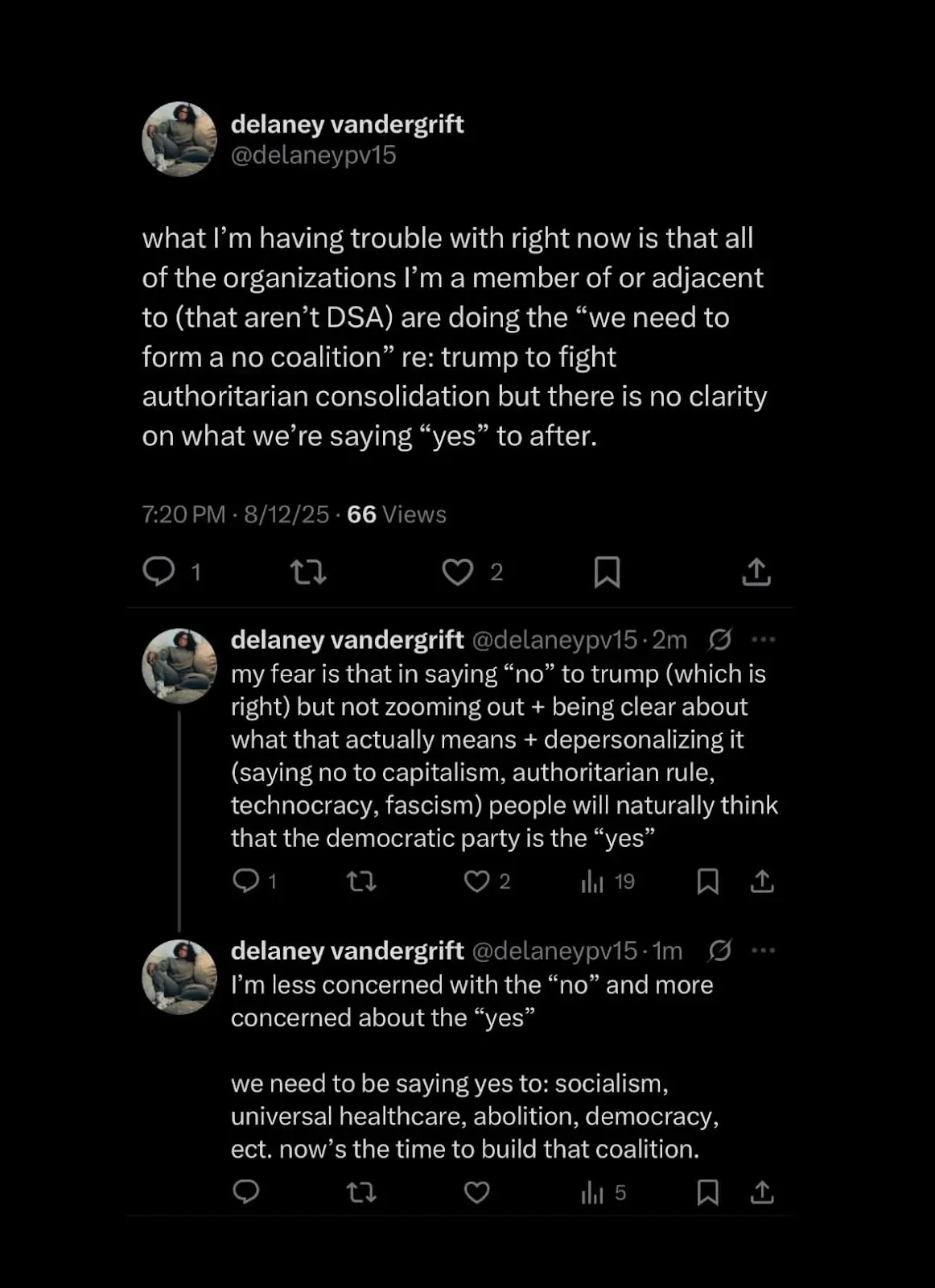
I love the United States greatly, which is why I want it to fail. The initial purposes and beliefs are what make this nation so unique and admirable. It is not lost on me that this nation was founded on the backs of slaves and through the death of indigenous people, yet I do believe it is our right as people who reside here to advocate for ourselves, to have a say in where our tax dollars are going (i.e. to not fund multiple genocides while the price of eggs continue to increase), and to not be murdered for having a voice. I was recently speaking with a loved one of mine, about the future and the present. What is it that Americans are willing to say “yes” to? The damage of late stage Capitalism is irreparable and very unlikely to be undone with the signage of a bill. However, when the American people step away from their screens and face the wind, what are they willing to sacrifice in the name of peace and community? Where will the division lay? Again, we find ourselves experiencing the early stages of an authoritarian regime that was once fought against and won. If the United States were to fall, and its people rose against the leaders, will the “American Spirit” be reclaimed and renewed? Creating a dream come true for many or enduring the hazy nightmare we currently face? And lastly, what will be the tip of the iceberg?
Resources:
The Coercive (Intolerable) Acts of 1774 | George Washington's Mount Vernon
Intolerable Acts | 1774, Definition, Summary, Significance, & Facts | Britannica
Third Amendment History: How British Soldiers in Colonial Homes Sparked Revolution | GovFacts
Quartering Acts of 1765 and 1774 | Summary, Facts, Reaction - AmericanRevolution.org
Depression Symptoms Can Include Anger, And That's Often Misunderstood : Shots - Health News : NPR
US Treasury now accepts Venmo and PayPal donations to reduce the $36.7 trillion national debt
Is Hulu shutting down? What to know about new Disney+ changes
Trump just revealed his new tariff plan. Here’s what you need to know | CNN Business
